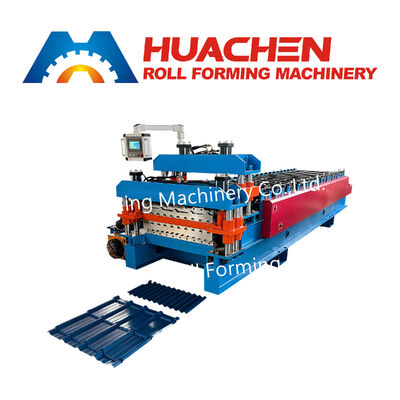
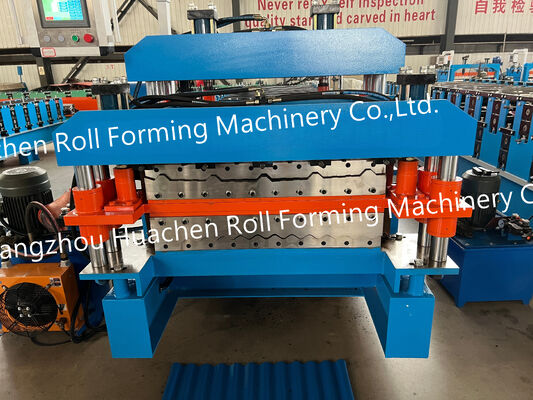
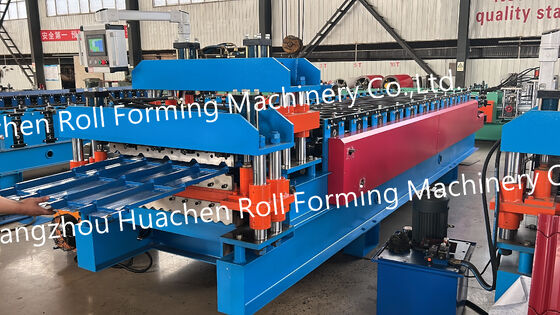
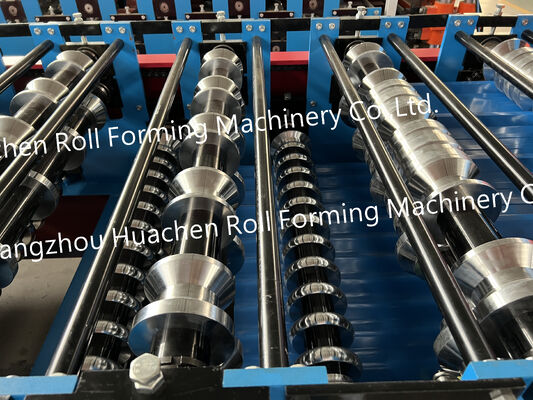
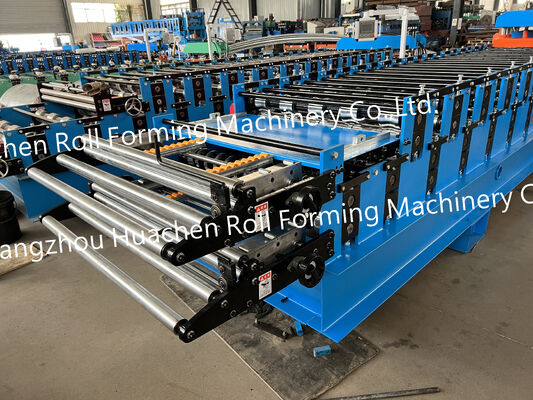
Main Technical Parameters
|
Roller Stations
|
Upper Layer: 11Stations
Down Layer: 12Stations
|
|
Roller & Shaft Material
|
45# Steel Quenching and Plating
|
|
Diameter of Shaft
|
Φ70mm
|
|
Cutter Material
|
CR12
|
|
Drive Type
|
Chain Drive
|
|
Speed
|
15-20m/min
|
|
Total Power
|
4+4KW
|
|
Voltage
|
380V 50Hz3Phases
|
Product Overview
Roll forming machines have applications covering almost every stage of the metal sheet production process, from raw materials to finished components. They are particularly suitable for profile products requiring mass production and with complex cross-sectional shapes but relatively standardized dimensions. Firstly, in the construction and steel structure sector, they are commonly used to produce C-shaped, U-shaped, and Z-shaped steel components, as well as various keels, purlins, and wall/roofing system profiles. These components are widely used in light steel structure housing, industrial plants, warehousing and logistics facilities, and curtain wall cladding systems. Because roll forming allows for continuous forming and stable length measurement, it ensures cross-sectional consistency and accuracy even at high production volumes, thereby improving construction and assembly efficiency and reducing errors caused by on-site cutting.
Secondly, in roofing and cladding systems, roll forming machines can manufacture corrugated steel sheets, roof panels, wall panels, and matching folding and connecting structures with different waveforms and rib shapes. For building exterior cladding components requiring waterproofing, windproofing, and insulation systems, the forming machine can create stable overlapping structures and reinforcing ribs according to design requirements, improving the product's rigidity and durability. Many projects utilize factory production followed by on-site installation, which helps shorten construction time, reduce labor costs, and minimize quality fluctuations.
Furthermore, in the industrial manufacturing and equipment supply sectors, roll forming machines are commonly used to produce various general-purpose profiles and functional components, such as cable trays, brackets, frame profiles, door and window frames, stair treads, and cabinet shell folding parts. As long as the material shape can be achieved through sequential bending by the roller system, the forming machine can flexibly adapt to different cross-sections. For users, the roller system and molds can be customized according to drawings, supporting different thickness ranges and material types (such as galvanized steel, color-coated steel, stainless steel, and aluminum), making it suitable for highly customized orders.
Overall, the core advantages of roll forming machines are "high efficiency, low material waste, good dimensional consistency, and sustainable large-scale production." Therefore, they are widely used in building envelopes, steel structure components, and industrial profile processing, enabling the rapid transformation of complex metal cross-sections from design drawings into standardized components directly applicable to engineering projects.


 Your message must be between 20-3,000 characters!
 English